You Do Not Need Another AI Tool. You Need to Fix This First.
By Agnes Goh
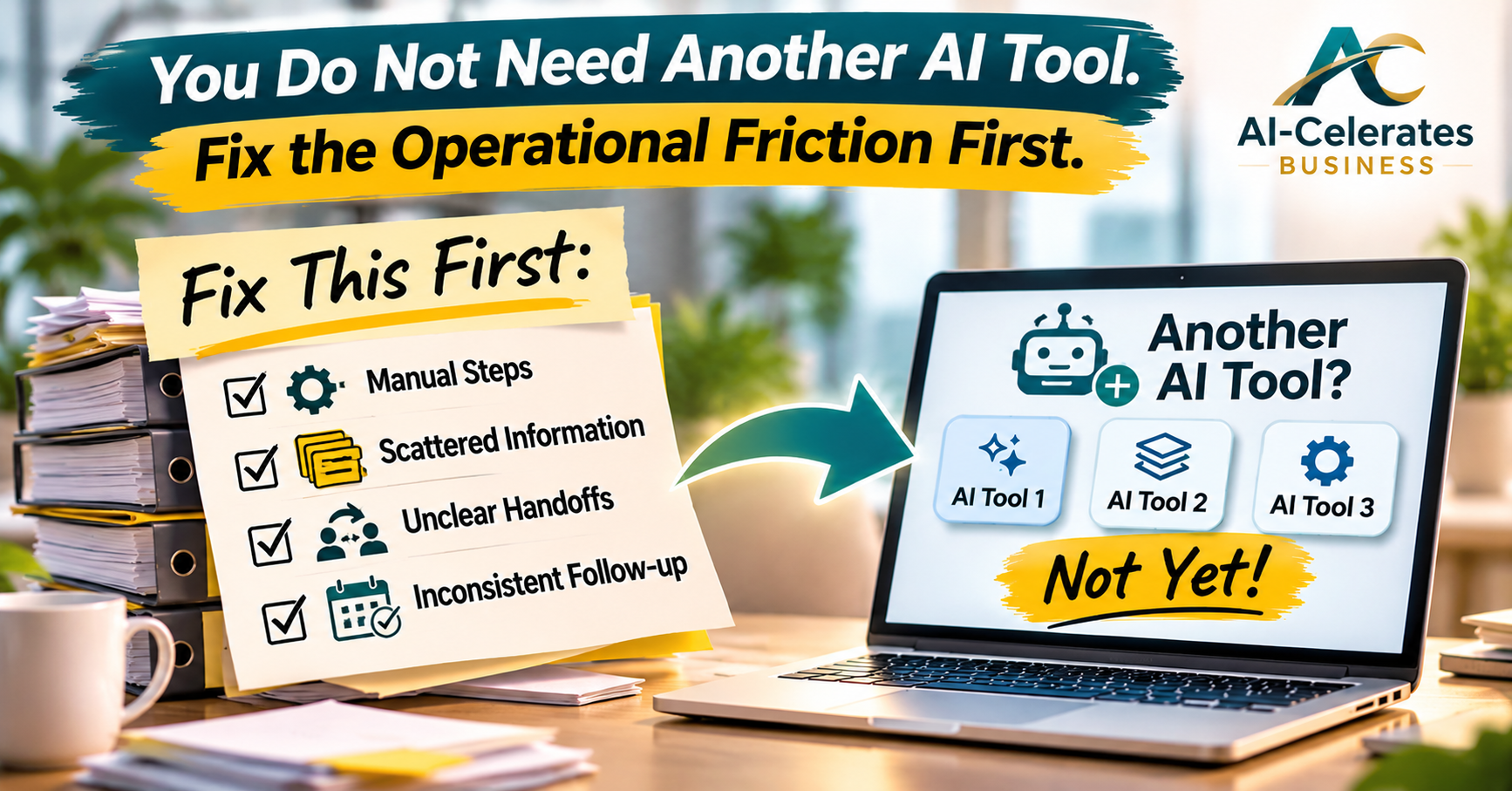
Most business owners do not have an AI-tool problem.
They have a work problem.
The team is copying information from one system to another. Follow-up depends on someone remembering. Important details sit in inboxes, documents and people's heads. Reports are assembled by hand. A customer asks a question and the answer depends on who happens to respond.
Then another AI tool arrives and promises to fix everything.
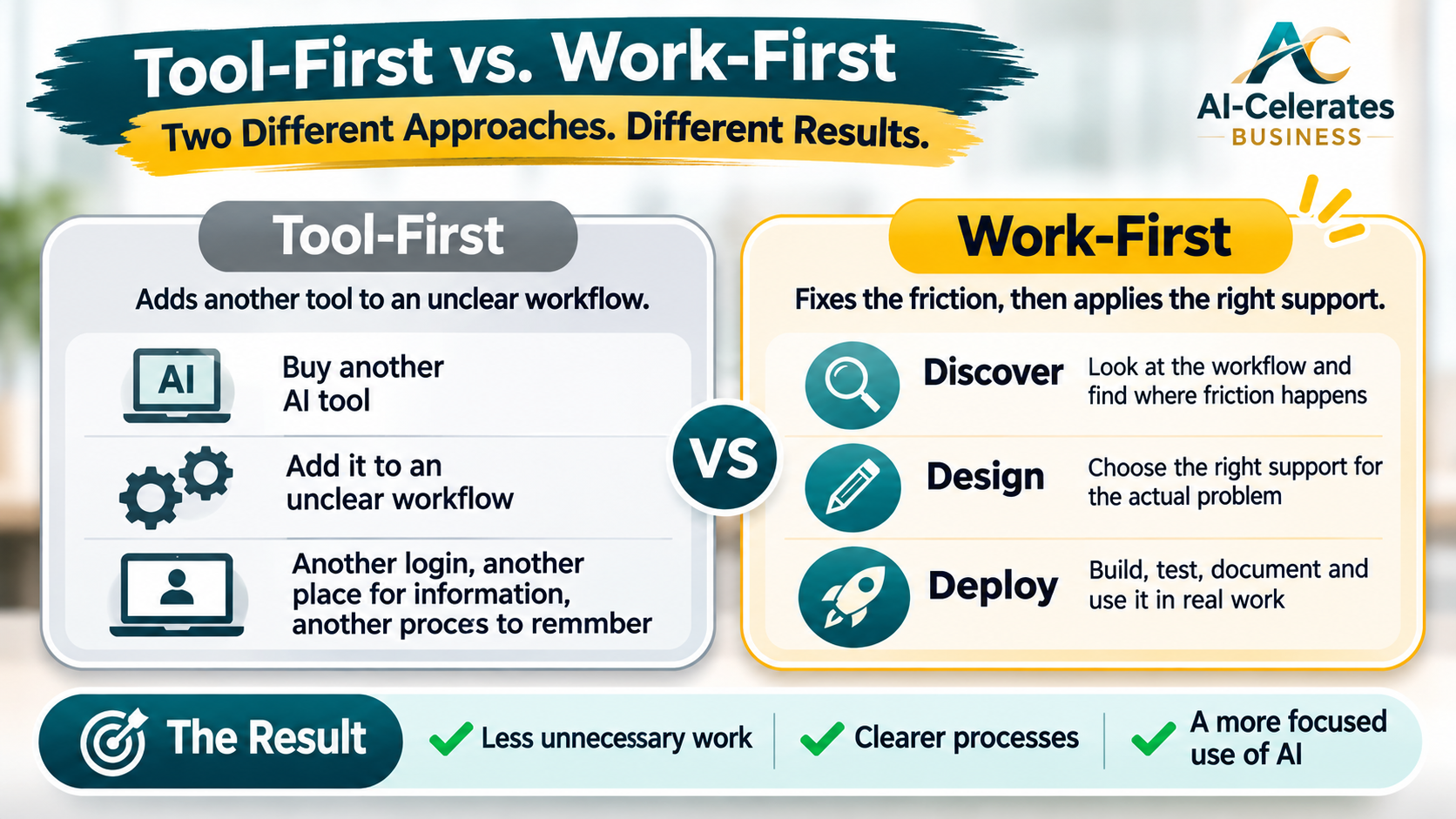
It is tempting to think the next tool will solve the issue. Sometimes a new tool helps. But when the underlying workflow is unclear, adding technology can create another place for information to live, another login to manage and another process your team has to remember.
Start with the friction
Before choosing a tool, look at the work itself.
Where does the process slow down? Where is information entered twice? Which questions keep coming up? Where do leads wait too long? Which tasks rely on one person knowing what to do next?
Those are not small annoyances. They are signs of operational friction.
Operational friction is the work that creates drag in a business. It can show up as manual steps, unclear handoffs, disconnected tools, scattered knowledge or inconsistent follow-up. It costs time and capacity, but it also makes growth harder. The more the business grows, the more people create workarounds to keep things moving.
AI can be part of the answer. It is not always the starting point.
A broken process does not become better because it becomes faster
If a lead-follow-up process is unclear, automating it can send the wrong message faster.
If customer information is scattered, an AI assistant may have incomplete context.
If the team has no agreed process for onboarding, a new tool may simply add another checklist that nobody uses.
The first question is not, "Which AI tool should we buy?"
It is, "What is happening in the work today?"
Once that is clear, the right support becomes easier to see. It may be a cleaner workflow. It may be a system connection. It may be better documentation. It may be a Company Brain, an AI assistant or an automated follow-up sequence. Often, it is a combination.
What a practical first step looks like
Choose one repeated problem. Keep it specific.
For example:
- Website inquiries are not being followed up consistently.
- The team spends too much time copying information between systems.
- New staff keep asking the same questions because the information is hard to find.
- Client updates are written from scratch every week.
- The owner is still the default source of truth for too many decisions.
Then map the process as it works now. Who starts it? What information is needed? What happens next? Where does it stop, wait or get repeated?
You do not need a complicated diagram. You need an honest view of the work.
Discover before you design
At AI-Celerates Business, we use a simple approach: Discover, Design, Deploy.
Discover means looking at the workflow, the people involved, the information required and the points where friction appears.
Design means choosing the right support for the actual problem. That may include better process, automation, AI support, a knowledge system or training.
Deploy means building, testing, documenting and helping people use the solution in real work.
This matters because a demonstration is not the same as a working system. A useful solution has to fit the business, the team and the way work gets done.
The point is not more AI
The point is less unnecessary work.
A good implementation should make it easier to find approved information, respond to customers, move work forward and give the team clearer support. If it adds confusion, creates another disconnected tool or depends on one person managing it, it is not solving the right problem.
Before you add another AI tool, look at the work that is already creating friction.
That is usually where the useful opportunity is.
Before you add another AI tool, let's look at the work it is supposed to fix. Book a Free Discovery Call and we'll help you identify where the friction is showing up and what kind of support actually makes sense.
Book a Free Discovery Call