Why Does AI Sound So Polished, Yet Say So Little?
By Agnes Goh
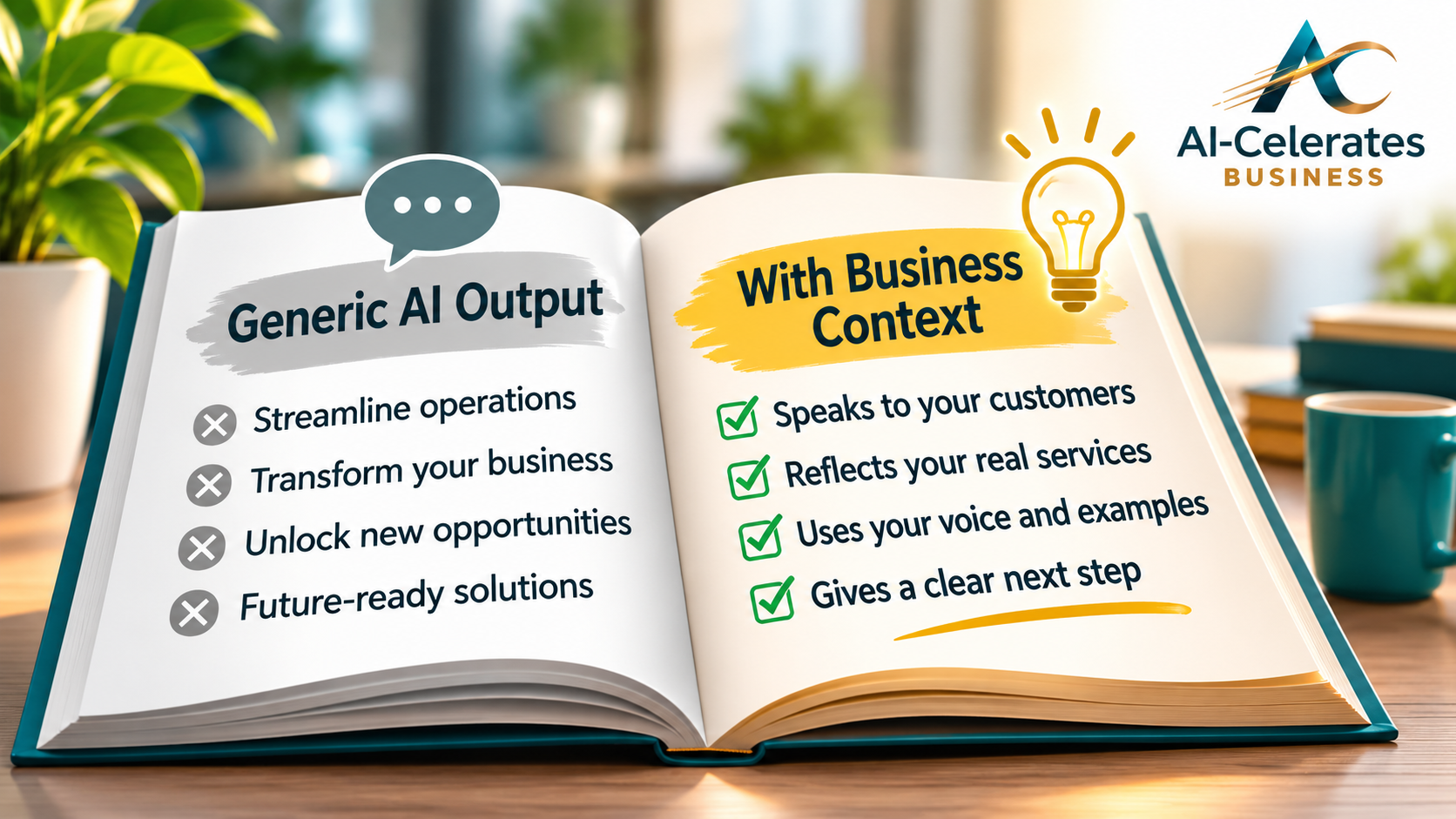
You ask an AI tool to write an email, a service description or a client update.
It comes back quickly. The grammar is clean. The tone is confident. The sentences sound professional.
But something is missing.
The answer could belong to almost any company. It does not sound like you. It does not reflect your customers, your actual services or the way you make decisions. It says a lot of familiar words without giving a reader much they can use.
That is not unusual. It is what happens when a general tool is asked to produce a business-specific answer without enough business-specific context.
General intelligence is not business context
Tools such as ChatGPT, Claude and Gemini are designed to be broadly useful. They can help with many subjects, industries and tasks.
They do not automatically know your business.
They do not know which services are current, which offers are still being developed, how your team describes a problem, what you have promised clients or which language you have decided not to use.
When those details are missing, AI fills the space with broad patterns. The result may be polished, but it is often generic.
More prompting is not always the answer
A longer prompt can improve an answer. Providing an example can help. Giving the tool a clearer role can help too.
But if the underlying information is scattered, unclear or out of date, the prompt has to carry too much weight. Every new task starts from zero. Every person on the team gives the tool different instructions. Every answer needs heavy editing because the AI does not have a reliable source of truth.
That is not a sustainable way to use AI for repeated business work.
Specificity comes from real information
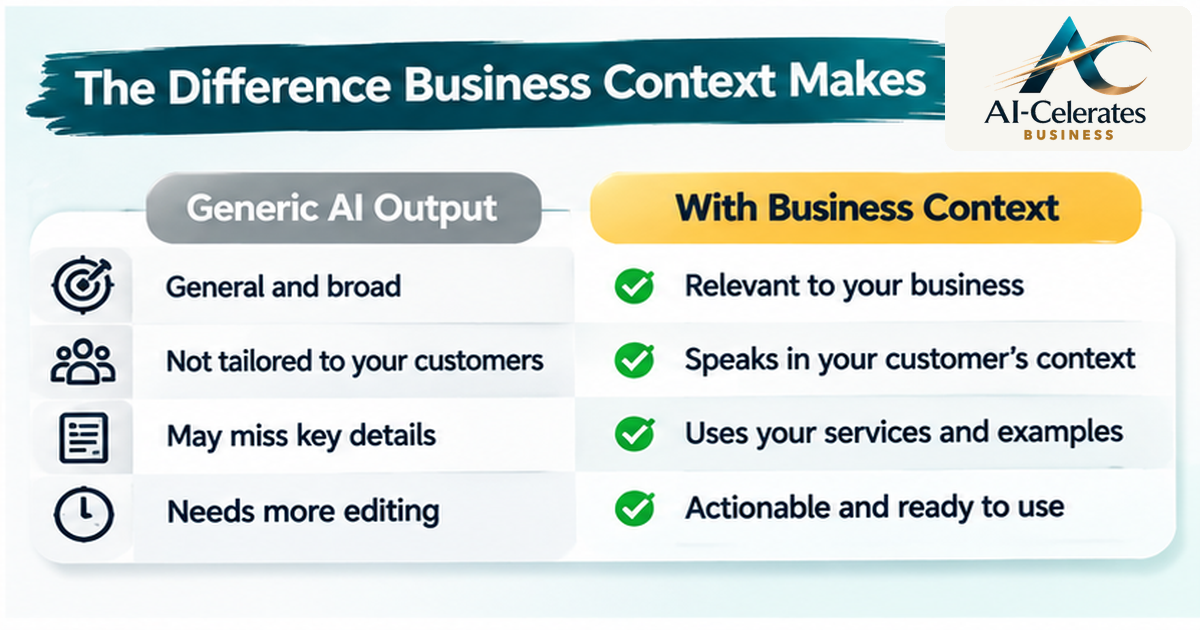
Useful business writing includes details.
It names the problem the customer recognizes. It describes the service in plain language. It uses the company's actual point of view. It gives the reader a clear next step.
AI can support that work when it has the right context: approved services, common questions, customer language, examples, voice guidelines and decision rules.
Without those things, it will reach for phrases that sound familiar. "Streamline." "Transform." "Unlock." "Future-ready." The sentences may look polished, but they do not tell a customer what will actually happen.
The answer still needs a person
Better context does not remove the need for human judgment.
A person still needs to decide whether the answer is accurate, appropriate and useful. Someone needs to notice when a claim cannot be supported, when a client situation is unusual or when a message needs more care.
AI can draft. It can organize. It can help a team work faster.
It should not be left to invent the business story.
A practical way to improve the output
Before asking AI to write, give it a better starting point.
Share the approved service description. Show it a real example of the tone you want. Explain the audience and the point of the piece. State what it must not claim. Ask for a specific outcome, not a vague topic.
For repeated work, organize that information once rather than rebuilding the prompt every time.
That is where a Company Brain or Specialized Brain Suite becomes useful. It gives AI a more reliable foundation and gives the team a more consistent way to work.
AI should not sound impressive and empty.
It should help you say something clear, specific and useful.
If your AI output keeps sounding generic, book a Free Discovery Call to explore what context may be missing.
Book a Free Discovery Call